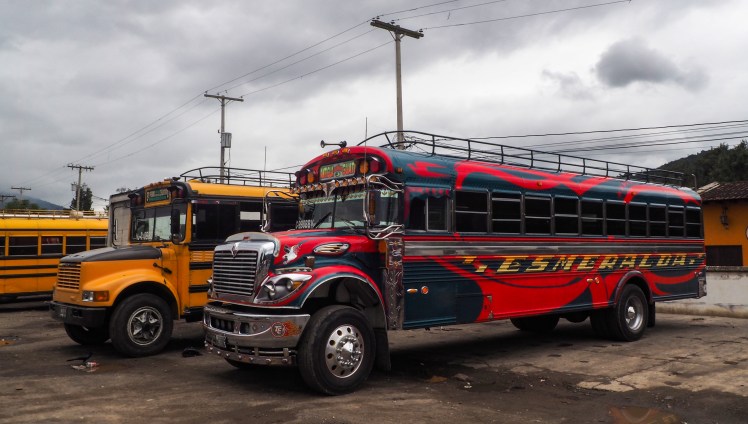
Getting from Monteverde in Costa Rica to the border with Nicaragua involved 3 different buses. We got up early and took the first one at 6am that dropped us off at the highway, then flagged down a passing bus to a town called Liberia. Once there, we hopped on the final bus to take us to the border. The border was fairly straightforward and we walked across to the Nicaraguan side. I like walking across borders, it feels a lot more satisfying than crossing in a bus for some reason. The difference between the two countries was immediately evident and the contrast reminded me of when we crossed from Argentina to Bolivia. Once through Nicaraguan immigration, we passed heckling taxi drivers into the public bus station and were hurried onto a chicken bus. Chicken buses are retired old US school buses which are now used as public buses in Central America. Some are still yellow, whilst others have been given colourful paint jobs. All feel like they could break down at any moment. As with collectivos in South America, they are operated by a driver and his helper, who shouts the destination of the bus out the front door at each stop. There are no predetermined stops, you just tell the driver when you want to hop off and they will pick up anyone who flags the bus down. If there is a maximum allowed number of passengers for the buses, it is certainly not enforced. Apparently no matter how many people there are on board, there is always room for one or two more.
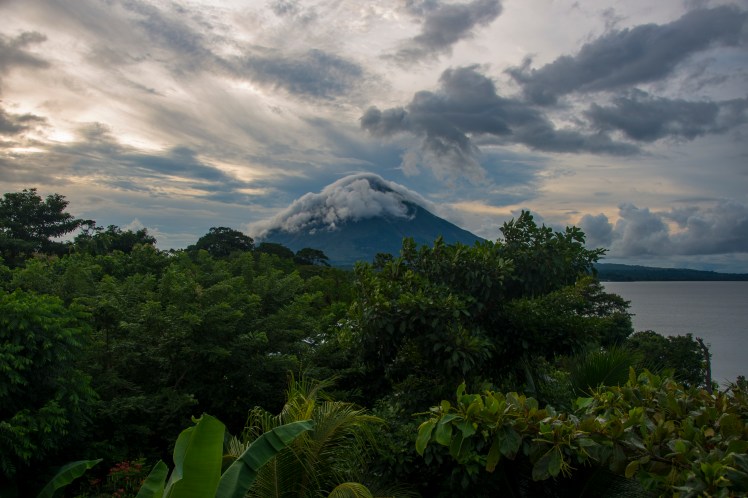
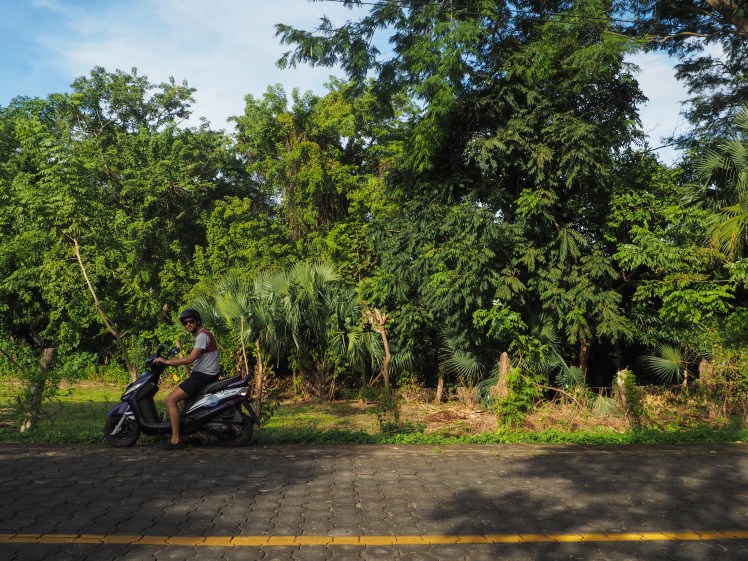
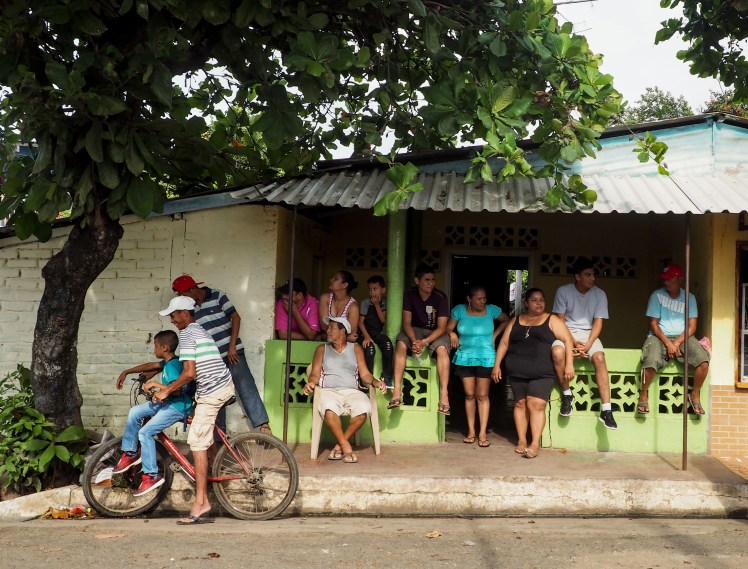
A chicken bus, taxi and ferry ride later, we arrived at Ometepe, a stunning twin volcano island in the enormous Lake Nicaragua. Concepcion is the active and more imposing of the two volcanoes, whilst Maderas lies dormant to the south. We were planning on staying two nights at each end of the island, but ended up staying four in Moyogalpa, the main town and where the ferry lands. We’d heard that bedbugs are a big problem on the island, so when after our first night we realised we had a place without them, we didn’t want to risk moving. We explored Ometepe by hiring bikes one morning, and hiring a scooter for another day. Both were great ways of seeing the island, as the buses are sporadic and taxis are expensive. Andrew climbed Concepcion one morning and afterwards we were lucky to catch the Ometepe Expo, which of course included a big parade and lots of street food. The people of Ometepe seemed so relaxed and friendly. Our trip to the museum even included a five minute break in the middle where the staff gave us a free shot of tequila, something that was very unexpected but should probably be made standard practice at all museums.



From Ometepe, we made the short trip to the colonial town of Granada, on the western shore of Lake Nicaragua. We did a week of Spanish lessons there whilst staying with the lovely family who own the school. It was a great insight into daily life in Granada. Our classes were in the mornings and during the afternoons we studied at cafes, played with the kids in our homestay and explored the city. On our free days we visited Catarina, a nearby small town with great view of Laguna de Apoyo, and Masaya, an active volcano where we saw lava for the first time! At Masaya, visits to the crater are restricted to 15 minutes and the rangers let about 70 people in at a time. The sight and sounds of the volcano were so fascinating that the 15 minutes felt like 2.
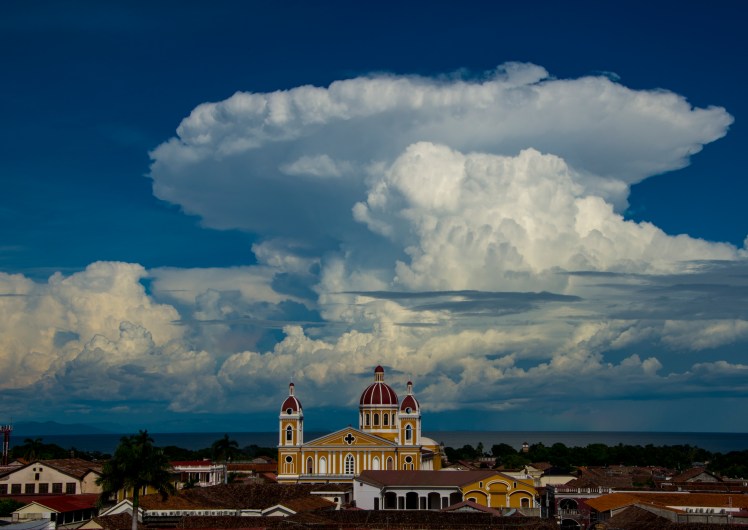

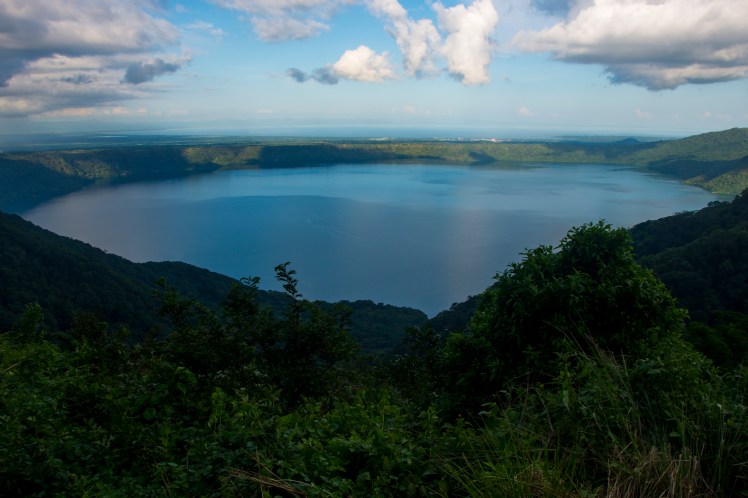

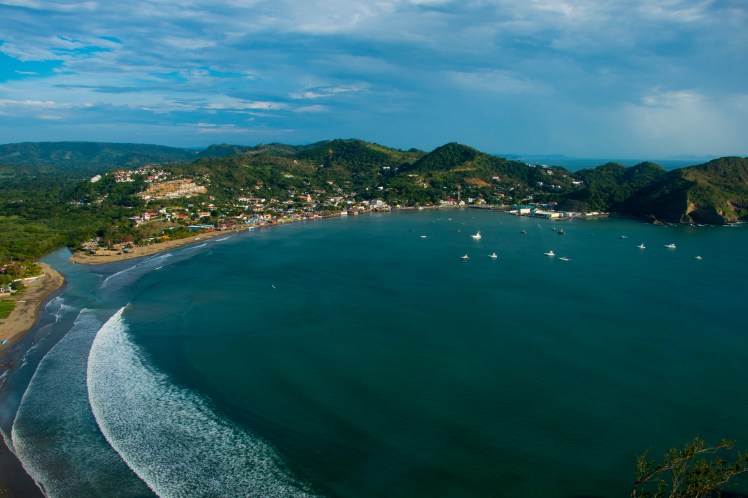
Tropical storm Nate hit whilst we were here, during which 43 people sadly died in Central America. We were lucky that all we experienced in Granada was a couple of days of heavy rain. The damage in the Pacific coastal town of San Juan del Sur was a lot worse. We stayed there for a couple of nights after Granada and there were many damaged sail boats stranded on the beach that had been smashed onto the sand during the storm. Some of the restaurants along the waterfront had also been hit fairly badly. We did a surfing lesson at a beginners spot just outside of town. It was fun, but I am definitely not a natural which I’m sure won’t come as a surprise to anyone.


Our final three nights in Nicaragua were spent in Leon, the grungier sibling of Granada. Leon is a university town and has more restaurants and bars spread throughout the city centre than Granada, whose restaurant strip felt overly touristy with staff out the front hassling you to come in. Nicaragua’s political history is long and complicated, and Leon’s colourfully patchy colonial era facades have borne witness to their fair share of the bloodshed. The city was one of the sites of the 1979 revolution, during which the long running Somoza dictatorship was overthrown. The Somoza family had controlled Nicaragua for 43 years and three members of the family were president for 30 of these. During their reign, the illiteracy rate in Nicaragua rose to an unbelievable 50%. The rebel group FSLN was formed in 1961 by left wing ‘Sandanistas’, who aimed to end Somoza rule. The FSLN gained power after the revolution, but conflict soon returned with the start of a civil war between the government and the ‘Contras’, who were supported by some members of the Reagan administration, using funds gained from the secret sale of weapons to Iran. This was a proxy conflict of the Cold War during which the Contras committed many human rights violations and the FSLN were accused of widespread media censorship. The FSLN were voted out in 1990, however the party was re-elected in in 2007 with Daniel Ortega as their leader.


We visited the Museum of the Revolution in Leon, run by men who fought against the Somoza regime during the revolution. It was such a powerfully emotive experience listening to our guide tell the story of his involvement whilst looking at photos of Leon during the conflict, one of which he appeared in.
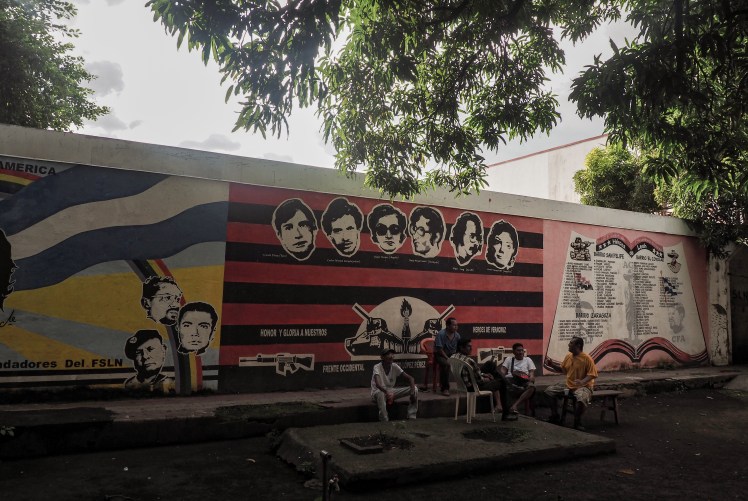
Nicaragua was the first country in Central America where I felt we had spent a decent amount of time, and I felt that we learnt a lot more about its history than when we were passing through Costa Rica and Panama. Unfortunately, there have been recent episodes of violence in the east between the FSLN and another political party following a local election, and there are ongoing and sometimes violent land disputes between indigenous groups and farmers. The most recent national elections, whereby Ortega won his third term as president, have been heavily criticised as being fraudulent. I hope that the coming years bring more stability, and that history does not repeat itself.
Erin
 dred
dred 